
If your salary is around 10 lakh per year, you’re probably paying far more tax than necessary.
Many salaried professionals assume tax is fixed. But in reality, the Indian tax system allows multiple deductions that can reduce your taxable income significantly.
The goal of this guide is simple.
We will walk step by step through how to save tax on 10 lakh salary using real numbers.
You will see your tax dropping after every step.
By the end of this guide, you will clearly understand:
- how much tax you actually owe
- where you are overpaying
- exactly which investments reduce tax
- whether old regime or new regime is better
Let’s start with the baseline.
Step 1: Your Starting Point -Tax on 10 Lakh Salary With No Deductions
Assume your gross salary = ₹10,00,000 per year
We first calculate tax under both tax regimes without any deductions.
New Tax Regime Calculation (2025–26)
Income Slabs:
0 – 3 lakh → 0%
3 – 6 lakh → 5%
6 – 9 lakh → 10%
9 – 12 lakh → 15%
Tax calculation:
0 – 3 lakh → ₹0
3 – 6 lakh → ₹3,00,000 × 5% = ₹15,000
6 – 9 lakh → ₹3,00,000 × 10% = ₹30,000
9 – 10 lakh → ₹1,00,000 × 15% = ₹15,000
Total tax = ₹60,000
Add 4% cess:
₹60,000 × 4% = ₹2,400
Final tax = ₹62,400
Also read: Old Tax Regime vs New Tax Regime – Why This Choice Matters in 2025-26
Old Tax Regime Calculation (No Deductions)
Old regime slabs:
0 – 2.5 lakh → 0%
2.5 – 5 lakh → 5%
5 – 10 lakh → 20%
Calculation:
0 – 2.5 lakh → ₹0
2.5 – 5 lakh → ₹2,50,000 × 5% = ₹12,500
5 – 10 lakh → ₹5,00,000 × 20% = ₹1,00,000
Total tax = ₹1,12,500
Add cess (4%)
₹1,12,500 × 4% = ₹4,500
Final tax = ₹1,17,000
Starting Comparison
New Regime Tax = ₹62,400
Old Regime Tax = ₹1,17,000
At first glance, the new regime looks better.
But the real question is this:
Can deductions bring old regime tax even lower?
Yes. Dramatically.
Let’s reduce your tax step by step.
If you want to calculate your own numbers instantly, you can Ask Vitta to calculate your exact tax
Step 2: Standard Deduction
Every salaried employee gets a standard deduction.
Old regime: ₹50,000
New regime: ₹75,000
New Regime After Standard Deduction
Salary = ₹10,00,000
Standard deduction = ₹75,000
Taxable income =
10,00,000 − 75,000 = ₹9,25,000
Tax calculation:
0 – 3 lakh → ₹0
3 – 6 lakh → ₹15,000
6 – 9 lakh → ₹30,000
9 – 9.25 lakh → ₹25,000 × 15% = ₹3,750
Total tax = ₹48,750
Add cess = ₹1,950
Final tax = ₹50,700
Old Regime After Standard Deduction
Salary = ₹10,00,000
Standard deduction = ₹50,000
Taxable income = ₹9,50,000
Tax:
0 – 2.5 lakh → ₹0
2.5 – 5 lakh → ₹12,500
5 – 9.5 lakh → ₹4,50,000 × 20% = ₹90,000
Total tax = ₹1,02,500
Add cess = ₹4,100
Final tax = ₹1,06,600
Running total:
New regime = ₹50,700
Old regime = ₹1,06,600
Now we start using deductions.
Step 3: Section 80C — Deduction up to ₹1.5 Lakh
This is the most widely used tax saving section.
Maximum deduction = ₹1,50,000
Eligible investments include:
- EPF contribution
- PPF
- ELSS mutual funds
- Tax saving FD
- National Savings Certificate
- Sukanya Samriddhi
- Life insurance premium
- Tuition fees
Most salaried employees already contribute EPF through salary.
Example:
EPF deduction per year = ₹60,000
So additional investment required:
1,50,000 − 60,000 = ₹90,000
Best 80C Investments Ranked
- EPF – automatic + guaranteed
- ELSS mutual funds – highest potential returns
- PPF – safe long-term option
- Tax saving FD – low return but simple
- NSC – government backed
ELSS usually wins because it has 3 year lock-in and equity returns.
New Taxable Income (Old Regime Only)
Old regime taxable income:
9,50,000 − 1,50,000 = ₹8,00,000
Tax calculation:
0 – 2.5 lakh → ₹0
2.5 – 5 lakh → ₹12,500
5 – 8 lakh → ₹3,00,000 × 20% = ₹60,000
Total tax = ₹72,500
Add cess = ₹2,900
Final tax = ₹75,400
Tax reduced from:
₹1,06,600 → ₹75,400
Tax saved = ₹31,200
Step 4: Section 80D — Health Insurance
Health insurance gives another deduction.
Limits:
Self + spouse + children → ₹25,000
Parents → ₹25,000
If parents are senior citizens → ₹50,000
Example:
Self policy premium = ₹18,000
Parents policy premium = ₹25,000
Total deduction = ₹43,000
Updated Taxable Income
Previous taxable income = ₹8,00,000
After 80D:
8,00,000 − 43,000 = ₹7,57,000
Tax:
0 – 2.5 lakh → ₹0
2.5 – 5 lakh → ₹12,500
5 – 7.57 lakh → ₹2,57,000 × 20% = ₹51,400
Total tax = ₹63,900
Add cess = ₹2,556
Final tax = ₹66,456
Tax saved compared to the previous step:
₹75,400 − ₹66,456 = ₹8,944
Step 5: Section 80CCD(1B) – NPS Additional ₹50,000
This is one of the most powerful tax deductions.
You can invest ₹50,000 extra in NPS beyond the 80C limit.
Deduction = ₹50,000
Updated Taxable Income
Previous income = ₹7,57,000
After NPS deduction:
7,57,000 − 50,000 = ₹7,07,000
Tax:
0 – 2.5 lakh → ₹0
2.5 – 5 lakh → ₹12,500
5 – 7.07 lakh → ₹2,07,000 × 20% = ₹41,400
Total tax = ₹53,900
Add cess = ₹2,156
Final tax = ₹56,056
Tax saved = ₹10,400
Step 6: HRA Exemption
HRA calculation uses three rules.
You can claim the lowest of these three.
- Actual HRA received
- Rent paid − 10% of basic salary
- 50% of basic salary (metro)
Example:
Salary = ₹10,00,000
Basic salary = ₹5,00,000
HRA received = ₹2,00,000
Rent = ₹15,000/month = ₹1,80,000
Calculation:
Rent − 10% of basic
1,80,000 − 50,000 = ₹1,30,000
50% of basic salary
= ₹2,50,000
Actual HRA received
= ₹2,00,000
Lowest value = ₹1,30,000
So HRA exemption = ₹1,30,000
Updated Taxable Income
Previous income = ₹7,07,000
After HRA exemption:
7,07,000 − 1,30,000 = ₹5,77,000
Tax:
0 – 2.5 lakh → ₹0
2.5 – 5 lakh → ₹12,500
5 – 5.77 lakh → ₹77,000 × 20% = ₹15,400
Total tax = ₹27,900
Add cess = ₹1,116
Final tax = ₹29,016
Step 7: Home Loan Interest (Section 24)
If you own a house purchased with a loan:
Interest deduction = ₹2,00,000
Updated Taxable Income
5,77,000 − 2,00,000 = ₹3,77,000
Tax:
0 – 2.5 lakh → ₹0
2.5 – 3.77 lakh → ₹1,27,000 × 5% = ₹6,350
Add cess = ₹254
Final tax = ₹6,604
Step 8: Education Loan Interest (Section 80E)
If you are paying an education loan:
Interest paid example = ₹80,000
Deduction = ₹80,000
Updated Taxable Income
3,77,000 − 80,000 = ₹2,97,000
Tax = ₹0
Because income is below ₹3 lakh exemption limit.
Step 9: Final Calculation — All Deductions Applied
Starting salary = ₹10,00,000
Deductions:
Standard deduction = 50,000
80C = 1,50,000
80D = 43,000
NPS = 50,000
HRA = 1,30,000
Home loan interest = 2,00,000
Education loan = 80,000
Total deductions:
= ₹6,03,000
Final taxable income:
10,00,000 − 6,03,000 = ₹3,97,000
Tax = ₹7,350
After rebate under Section 87A, tax becomes ₹0.
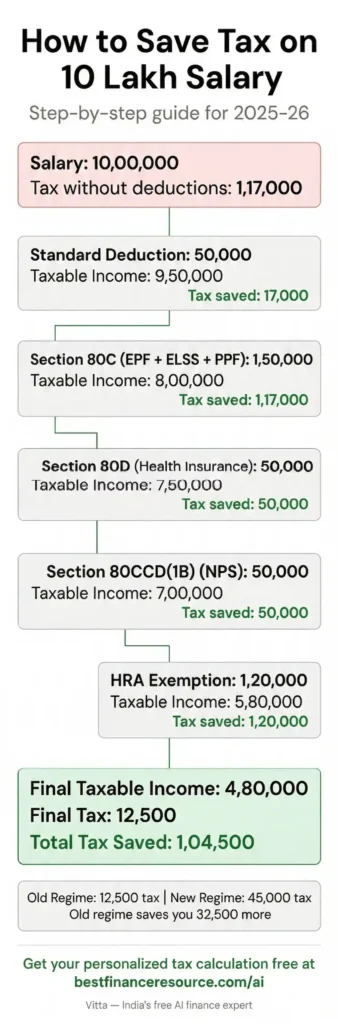
Step 10: Old vs New Regime Verdict for 10 Lakh Salary
New regime tax after deduction:
₹50,700
Old regime with deductions:₹0
Difference:
₹50,700 saved.
So for someone with deductions like HRA, NPS, insurance, and home loan, old regime clearly wins.
You can read a deeper breakdown here: old vs new tax regime comparison
Common Mistakes People Make When Saving Tax on 10 Lakh Salary
1. Ignoring EPF in 80C
Your EPF contribution already counts toward the ₹1.5 lakh limit.
Many people invest extra without checking.
2. Buying Insurance as an Investment
Traditional policies have poor returns.
Use term insurance for protection and ELSS or PPF for tax saving.
3. Not Claiming HRA
If you pay rent but do not submit rent receipts, you lose a deduction worth ₹20,000–₹40,000 tax savings.
4. Ignoring NPS Additional Deduction
The extra ₹50,000 NPS deduction alone can save around ₹10,400 tax per year.
5. Not Submitting Rent Receipts
Without documentation, HRA exemption gets rejected.
Best Tax Saving Investment Order
If your salary is around 10 lakh, this order works best.
- EPF (automatic deduction)
- ELSS mutual funds (best return potential)
- NPS 80CCD(1B) (extra ₹50,000 deduction)
- PPF (safe, long term)
- Health insurance under 80D
- Everything else
If you want a personalized calculation, you can Ask Vitta to calculate your exact tax here: bestfinanceresource.com/ai/
Vitta is India’s first free AI financial expert that answers personal finance questions with real numbers.
You can read about it here:
India’s first free AI financial expert
bestfinanceresource.com/blogs/indias-first-free-ai-financial-expert/
You can also Ask Vitta to calculate your exact tax based on salary, rent, and investments.
Conclusion: How to Save Tax on 10 Lakh Salary
A salary of 10 lakh per year does not mean you must pay high tax.
If you use the deductions correctly:
- Standard deduction
- 80C investments
- Health insurance
- NPS
- HRA
- Home loan interest
you can reduce your tax from ₹62,400 to nearly zero.
That is the real strategy to save tax on 10 lakh salary.
Not sure how much tax you can actually save?
Tell Vitta your exact salary, HRA, rent, and investments.
It calculates your tax under both regimes and tells you exactly what to invest where.
Takes 30 seconds. Free.
Ask Vitta to calculate your exact tax bestfinanceresource.com/ai/
Frequently Asked Questions
1. How much tax do I pay on 10 lakh salary?
Under the old regime, tax depends on deductions.
Under the new regime, a 10 lakh salary pays roughly ₹50,700 tax after standard deduction.
2. Can I save tax without investing?
Yes.
Standard deduction and HRA alone reduce taxable income.
3. Is 10 lakh salary taxable?
Yes.
But deductions can significantly reduce the final tax.
4. What is the maximum tax saving on 10 lakh salary?
With deductions like HRA, NPS, insurance, and home loan interest, tax can reduce to zero.
5. Should I choose old or new regime for 10 lakh salary?
If you claim multiple deductions like HRA, NPS, and 80C, old regime usually saves more tax.
6. Is NPS worth it for tax saving?
Yes.
It gives an extra ₹50,000 deduction beyond 80C.
7. How much HRA can I claim on 10 lakh salary?
It depends on rent, basic salary, and HRA received.
In many cases, exemption ranges between ₹80,000 and ₹1,50,000.